
High-ticket digital marketing is the process of attracting, nurturing, and converting premium buyers through trust-building channels, strong positioning, and a longer sales funnel. It’s not the same game as low-cost, high-volume marketing, and treating it that way is one of the fastest ways to burn a budget with nothing to show for it.
Premium buyers don’t decide on impulse. They research. They compare. They want proof before they commit. So the marketing approach has to match that behavior, with more trust, more personalization, and a longer runway before the sale actually closes.
This article explains what high-priced digital marketing entails, which channels are most effective, and how to create a funnel that accurately reflects the decision-making process of premium purchasers.
What Is High-Ticket Digital Marketing?
High-ticket digital marketing refers to promoting offers with a high price point, such as consulting, coaching, SaaS platforms, luxury products, or B2B services, using digital channels built around trust and relationship-building rather than quick conversions. The difference between high-ticket and low-ticket marketing comes down to decision-making. A low-ticket buyer might purchase on a whim after seeing one ad. A high-ticket buyer usually needs weeks or months, multiple touchpoints, and solid proof before they say yes. Common high-ticket offers include:
- Consulting and coaching programs
- Enterprise or premium SaaS subscriptions
- Luxury goods and services
- B2B services with long contracts
- High-end done-for-you services
If your offer sits in that range, your marketing strategy needs to reflect the weight of that decision.
Why High-Ticket Buyers Convert Differently
Understanding buyer psychology here matters more than any tactic.
They research more. High-ticket buyers compare options, read reviews, and often consult multiple sources before reaching out.
They trust social proof heavily. Case studies, testimonials, and client logos carry real weight, because the buyer is trying to reduce perceived risk.
They need stronger justification. A five-figure or six-figure decision usually has to be justified internally, whether that’s to a spouse, a business partner, or a board.
Multiple stakeholders are often involved. In B2B especially, the person who first finds your content rarely makes the final call alone. Your messaging needs to work for the whole buying committee, not just one reader.
The Best Channels for High-Ticket Marketing
Not every channel performs equally well for premium offers. The ones that consistently work:
- Google Search: captures buyers who already know they have a problem and are actively looking for a solution.
- LinkedIn: especially strong for B2B, where LinkedIn Sales Navigator can support account-based targeting.
- YouTube: long-form video builds trust faster than almost any other format, especially with testimonials or founder-led content.
- Email nurturing: keeps the relationship warm across a longer sales cycle.
- Retargeting ads: re-engage visitors who showed interest but weren’t ready to act yet.
- Personalized outreach: direct, one-to-one contact often closes the deal after digital channels build initial trust.
The strongest high-ticket strategies rarely rely on just one channel. They layer several together, so a prospect sees consistent proof points across multiple touchpoints.
High-Ticket Funnel Strategy
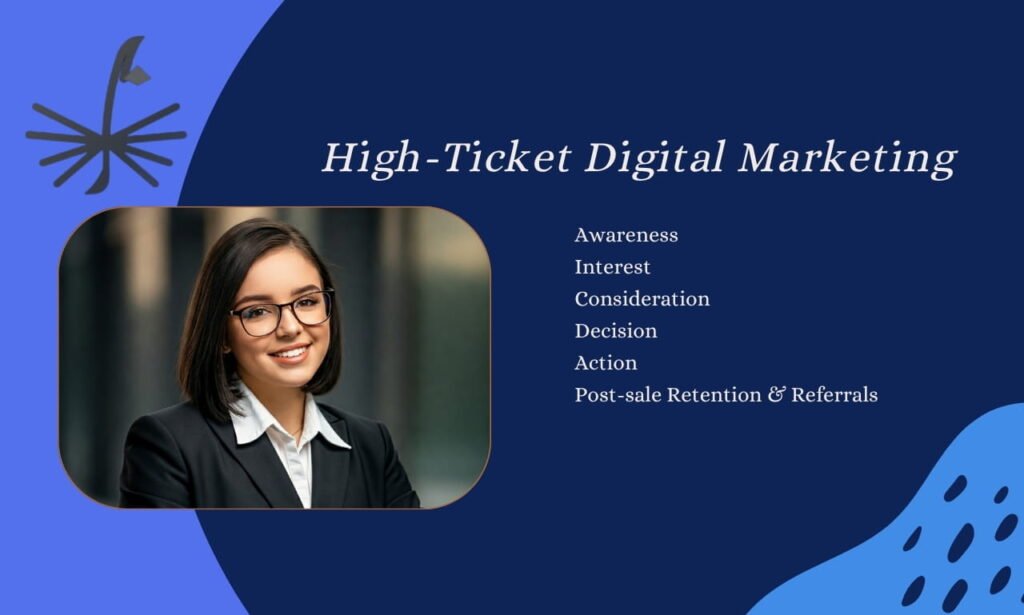
A high-ticket funnel usually moves through six stages:
- Awareness: The consumer finds your brand, frequently through content or search.
- Interest: They engage further, reading more content or watching a video.
- Consideration: They compare you against alternatives and evaluate proof.
- Decision: They weigh the final details, pricing, guarantees, and fit.
- Action: They make the purchase, schedule a call, or sign a contract.
- Post-sale retention and referrals: a strong experience turns clients into repeat buyers and referral sources.
Skipping stages is a common mistake. Pushing a cold lead straight to “book a call” rarely works for high-ticket offers, because the trust hasn’t been built yet.
How to Build Trust at Every Stage
Trust is the real currency in high-ticket marketing. A few tools do the heavy lifting:
- Case studies: show real, specific outcomes, not vague claims.
- Testimonials: short, credible, and ideally tied to a name or company.
- Reviews: third-party platforms add a layer of objectivity.
- Client logos: recognizable names build instant credibility.
- ROI calculators: help buyers picture the return before they commit.
- White papers: demonstrate deeper expertise, especially useful for B2B decision-makers.
Ideally, every stage of the funnel has at least one trust-building element attached to it.
SEO for High-Ticket Offers
SEO for high-ticket services looks different from SEO for everyday products. Volume matters less than intent.
- Long-tail, high-intent keywords tend to convert better than broad, high-volume terms.
- Buyers are actively weighing their options on comparison pages (“X vs Y”).”Best for” inquiries are useful for premium, specialist positioning.
- Problem-based content meets buyers earlier, while they’re still defining the issue.
- Service pages built for decision support, with clear pricing context, proof, and next steps, help move consideration-stage visitors forward.
A smaller number of well-targeted, high-intent visitors is usually worth far more than a large volume of unqualified traffic.
Paid Ads for High-Ticket Leads
Paid media works best when it’s layered with intent in mind.
- Search ads capture people already looking for a solution.
- Retargeting ads address objections and stay visible during the research phase.
- Personalized ads speak directly to specific audience segments or industries.
- Alignment of the landing page is as important as the advertisement itself. A mismatched landing page kills conversion rate, no matter how good the targeting is.
Email and Nurture Strategy
Since high-ticket decisions take time, email becomes one of the most important tools in the funnel.
- Segmented sequences speak differently to a cold lead versus a warm one.
- Educational content builds authority and keeps the brand top of mind.
- Objection handling addresses hesitations before they become deal-breakers.
- Demo booking and consultation flows guide ready leads toward a direct conversation.
A well-built nurture sequence often does more to close high-ticket deals than any single ad campaign.
How to Optimize for AEO, AIO, and LLMs
AI search tools and conversational search engines are increasingly part of how buyers research high-ticket decisions. A few ways to stay visible there:
- Use short answer blocks. Lead each section with a clear, direct answer.
- Add FAQ sections. These map naturally to how people phrase questions to AI tools.
- Define terms early. A clean, quotable definition near the top helps both search engines and AI summaries.
- Use entity-rich language. Mention specific concepts, tools, and terms clearly, rather than vague phrasing.
- Include examples, frameworks, and comparisons. These provide tangible content for AI technologies to extract and reference.
- Write in a citation-friendly format. Clear structure and factual accuracy make content easier to summarize correctly.
This same structure tends to help traditional SEO too, since well-organized, clearly written content performs well across the board.
Mistakes to Avoid
A few missteps show up again and again in high-ticket marketing:
- Chasing volume instead of quality leads.
- Weak or unclear positioning.
- Generic messaging that may be used against any rival.
- Missing proof, like case studies or testimonials.
- No follow-up system for leads who aren’t ready yet.
- Ignoring conversion tracking, which makes it impossible to know what’s actually working.
Most of these come from treating a high-ticket offer like a low-ticket one. The fix is usually slower, more deliberate marketing, not more aggressive marketing.
FAQs
What is high-ticket digital marketing?
High-ticket digital marketing is the strategy of promoting premium offers, like consulting, coaching, or enterprise services, through trust-focused channels and a longer, more deliberate sales funnel.
Which channel works best for high-ticket offers?
There’s no single best channel. Google Search and LinkedIn tend to perform strongly for capturing intent, while email nurturing and retargeting help move leads through a longer decision process.
How long does high-ticket marketing take to work?
It varies by industry, but most high-ticket funnels take weeks to months to convert a lead, since the buyer typically needs multiple touchpoints before deciding.
Is SEO effective for high-ticket services?
Yes, especially long-tail, high-intent SEO. It tends to attract fewer but far more qualified visitors compared to broad, high-volume keywords.
How do you market high-ticket services on Google and LinkedIn?
On Google, focus on high-intent search ads and SEO content built around specific problems and comparisons. On LinkedIn, use targeted content and outreach, often supported by tools like Sales Navigator, to reach the right decision-makers directly.